Home / Child Counselling / Remedial Therapy
Remedial Therapy for Children
Some children work hard and still struggle to read, spell, write or do sums. Remedial therapy gives them patient, structured support in the skills that are holding them back.
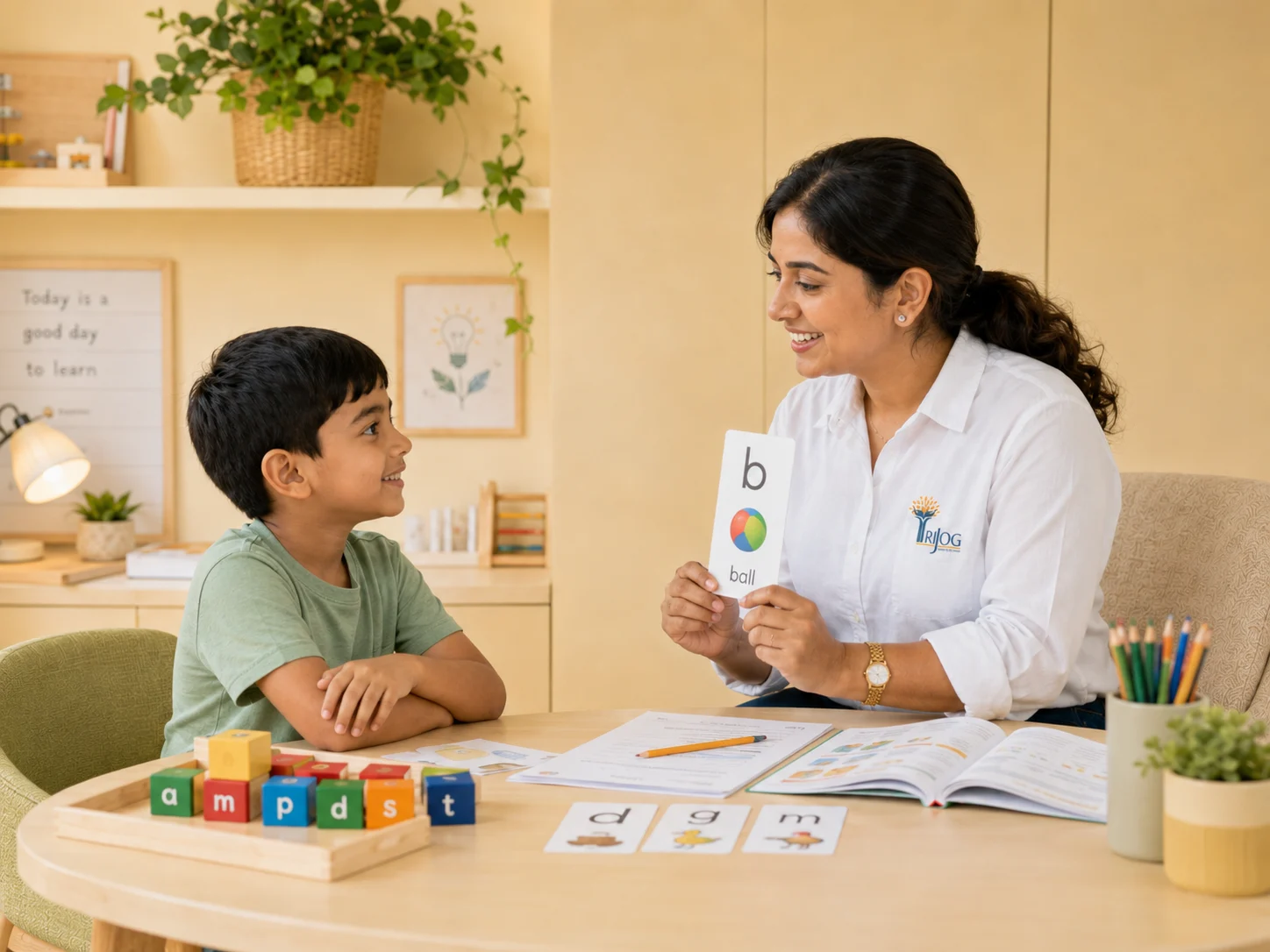
Trijog’s remedial educators work one to one with children, in person in Mumbai or online, alongside our child psychologists. We start with where your child is, not where the syllabus says they should be.
- One to one, at your child's pace
- In person at our Mumbai centres, or online
- Works alongside school
What We Help With
Pick what feels closest to what you are seeing. Not sure which one? That is fine, we can work it out in the first conversation.
Reading difficulties
Struggling to read fluently or understand what is read.
Your child may guess words from the first letter, lose their place, read slowly, or read a page and remember nothing. Reading aloud in class becomes something to dread.
- Mixing up similar letters or sounds
- Reading slowly and with effort
- Avoiding reading at home
- Trouble understanding what was read
Sessions build sound and letter skills step by step, using multi-sensory methods, then move to fluency and understanding.
Spelling and writing
Difficulty putting thoughts into written words.
Spelling the same word three ways on one page. Copying slowly from the board. Knowing the answer but not being able to write it down.
- Frequent spelling errors, even with common words
- Messy or slow handwriting
- Very short written answers
- Difficulty organising ideas on paper
Your child learns spelling patterns, planning tools and ways to organise writing, with handwriting support from our occupational therapists where needed.
Maths difficulties
Struggling with numbers, calculation or word problems.
Counting on fingers long after classmates have stopped, mixing up signs, or panicking at word problems. Maths anxiety often grows on top of the original difficulty.
- Difficulty remembering number facts
- Confusing plus, minus and other signs
- Struggling with word problems
- Anxiety or tears around maths homework
Work uses concrete materials and visual methods to build number sense, then step-by-step strategies for calculation and problems.
Attention and study skills
Knowing the content but struggling to show it.
Homework that takes hours, forgotten assignments, careless mistakes in exams. Some children need help with how to learn, not just what to learn.
- Homework that drags on every evening
- Forgetting instructions or materials
- Careless errors in tests
- Difficulty planning for exams
Your child learns practical study routines, planning and checking strategies, and ways to work with their attention rather than against it.
Learning difficulties such as dyslexia
Ongoing difficulty that does not match effort or ability.
When a child is clearly bright but learning stays unusually hard, a specific learning difficulty may be part of the picture. Formal assessment and certification are done by authorised professionals and centres.
- Persistent difficulty despite extra help
- A big gap between spoken and written ability
- Family history of learning difficulties
- Falling further behind each year
We support children with or without a formal diagnosis, and can guide you towards assessment when it would help, including for school or board accommodations.
Confidence and school anxiety
Feeling "stupid" or dreading school because of learning struggles.
Years of struggling can leave a child believing they are not clever. That belief often becomes a bigger barrier than the original difficulty.
- Saying "I am stupid" or "I can't do it"
- Avoiding homework or hiding test papers
- Stomach aches before school
- Giving up quickly on new tasks
Small, regular successes in sessions help rebuild confidence. Where anxiety is strong, our child psychologists can support that side too.
Also Here For You
Families often come to us for these too:
Occupational therapy
When handwriting, coordination or sitting still make learning harder.
Learn more
ADHD and attention support
When focus and restlessness get in the way of schoolwork.
Learn more
Childhood anxiety
When worry about school or tests has started to take over.
Learn more
Why This Kind Of Support Helps
Every child can learn
Children who struggle are rarely lazy. They often need the material taught a different way.
Confidence matters as much as skills
A child who believes they can learn tries harder and recovers faster from mistakes.
Starting from where they are
Filling gaps in basic skills makes everything built on top of them easier.
No Crisis Needed
You do not need to wait for a failed exam. Early support is usually easier on everyone.
How It Works
Reach out
Understand the gaps
Agree a plan
Review with you and school
What A First Session Is Like
Your child will not be tested in a way that feels like an exam. The first meeting is a chance to understand where learning feels hard, through conversation, simple activities and a look at recent schoolwork. You will hear what we noticed and what we suggest next.
Child Psychologists And Therapists
For assessment, therapy and practical guidance, in person or online.
A Specialist, If Needed
We can connect you with a paediatrician or psychiatrist when a medical opinion is worth having.
Parents, Always
You are part of the plan, with guidance on what to do at home.
For parents and families
Support at home makes a real difference to how quickly skills grow. A few things help.
- Keep homework time short, regular and calm, with breaks.
- Praise effort and strategies, not only marks.
- Read together for pleasure, without testing.
- Talk to your child's teachers early, so home and school pull in the same direction.
If a child needs help right now
- If a child talks about wanting to die, harm themselves or not wanting to be here, or you believe they are in danger, call 112 or go to the nearest hospital emergency.
- For free mental health support at any time, for you or your child, call the government's Tele-MANAS helpline on 14416 or 1-800 891 4416.
- Trijog is not an emergency service. Our sessions are by appointment, in person in Mumbai or online.
If any of these is happening, please do not wait for an appointment. Call 112 or go to the nearest hospital emergency. Tele-MANAS is free and open any time on 14416 or 1-800 891 4416.
Frequently Asked Questions
Remedial therapy, sometimes called remedial teaching, is structured one-to-one support for children who are struggling with core learning skills such as reading, writing, spelling or maths.
No. Tuition usually follows the school syllabus. Remedial therapy goes back to the underlying skills that are causing difficulty and uses specialised methods to build them.
No. We support children with or without a diagnosis, and can guide you towards formal assessment if it would help.
Formal certification is done by authorised professionals and centres. We can guide you on the process and support your child’s learning alongside it.
Yes, for many children, especially older ones. Younger children often do best in person.
If your child is working hard but still struggling, falling behind, or losing confidence about learning, it is worth an assessment.
Visit Our Centres
Meet your child’s therapist in person at one of our three Mumbai centres.
Powai
406, 4th Floor, B-Wing, Powai Plaza, opp. Nirvana Park, Hiranandani Gardens, Powai, Mumbai 400076
Phone: 1800 202 7180
Time: Mon to Sat, 8:00 AM to 10:00 PM
Directions & Google reviews
Bandra
Office No. G6, Bandra Nicholas C.H.S Ltd, Sherlyn Rajan Road, Rizvi Complex, Bandra West, Mumbai 400050
Phone: 1800 202 7180
Time: Mon to Sat, 8:00 AM to 10:00 PM
Directions & Google reviews
Prabhadevi
Dr. Palep's Polyclinic, Manoj Co-Operative Hsg Society, Shankar Ghanekar Marg, opp. Rachana Sansad College of Architecture, Prabhadevi, Mumbai 400025
Phone: 1800 202 7180
Time: Mon to Sat, 8:00 AM to 10:00 PM
Directions & Google reviews
Start With One Conversation
You do not need to have it all figured out. Tell us what you are seeing, and we will take it from there.
If a child is thinking of ending their life or harming themselves, or is unsafe right now, call 112 or go to the nearest hospital emergency. For free support any time, call the government’s Tele-MANAS helpline on 14416 or 1-800 891 4416. Trijog is not an emergency service. Outside India, call your local emergency number.
Educational content, not therapy or a diagnosis. A Trijog therapist can help with what is specific to your child.