
Home / Child Counselling / Behaviour Therapy
Behaviour Therapy for Children
Meltdowns over small things. Hitting a sibling. Refusing school, food or bedtime. Behaviour is how many children show what they cannot yet say, and it can change with the right support.
Trijog’s child therapists work with children and parents together, in person in Mumbai or online. We look at what the behaviour is doing for your child, then build calmer routines and new skills, one step at a time.
- Parents part of every plan
- In person at our Mumbai centres, or online
- Play-based and age-appropriate
What We Help With
Pick what feels closest to what you are seeing. Not sure which one? That is fine, we can work it out in the first conversation.
Tantrums and meltdowns
Big outbursts that seem far bigger than the trigger.
A switched-off screen, the wrong cup, a change of plan. The child goes from fine to inconsolable in seconds, and the whole household learns to tiptoe. Most children grow out of some of this, but when it is frequent and intense, it is worth working on.
- Outbursts several times a day, or that last a long time
- Throwing, hitting or breaking things when upset
- Struggling with any change in routine
- Taking a long time to calm down afterwards
Your therapist helps you spot the early signs and the triggers, plan what to do before, during and after an outburst, and teach your child small calming skills that fit their age.
Aggression and hitting
Hurting others when angry, frustrated or overwhelmed.
Biting, hitting, kicking or pushing, at home, at school or with siblings. Parents often feel judged, and the child often feels like the “bad one”. Neither helps.
- Hitting or biting siblings, parents or classmates
- Complaints from school or the playground
- Aggression that has increased recently
- Remorse afterwards, but it keeps happening
Work focuses on what happens just before the aggression, safer ways to show big feelings, and consistent, calm consequences that everyone at home can follow.
Not listening and defiance
Refusing instructions, arguing back, testing every limit.
Every request turns into a negotiation or a standoff. Shouting starts to feel like the only thing that works, and then it stops working too.
- Ignoring instructions until voices are raised
- Arguing about every rule
- Deliberately doing the opposite
- Different behaviour with each parent or grandparent
Parents learn clear, calm ways to give instructions, praise what goes right, and follow through. Children learn that the rules are predictable, which tends to reduce the testing.
Routines: sleep, food and screens
Daily routines that turn into daily battles.
Bedtime that stretches past midnight, mealtimes that end in tears, or screen time that cannot end without a fight. These are some of the most common reasons families come to us.
- Long or late bedtimes
- Very fussy eating or mealtime fights
- Meltdowns when screens are switched off
- Mornings that start with conflict
Together you design simple routines, visual schedules and transition warnings that fit your household, including the grandparents and helpers who share the care.
Social behaviour and friendships
Difficulty getting along, sharing or making friends.
Some children grab, push in or take over games. Others hang back and watch. Either way, friendships feel hard, and school can feel lonely.
- Struggling to share or take turns
- Few or no close friends
- Being left out or leaving others out
- Misreading other children's reactions
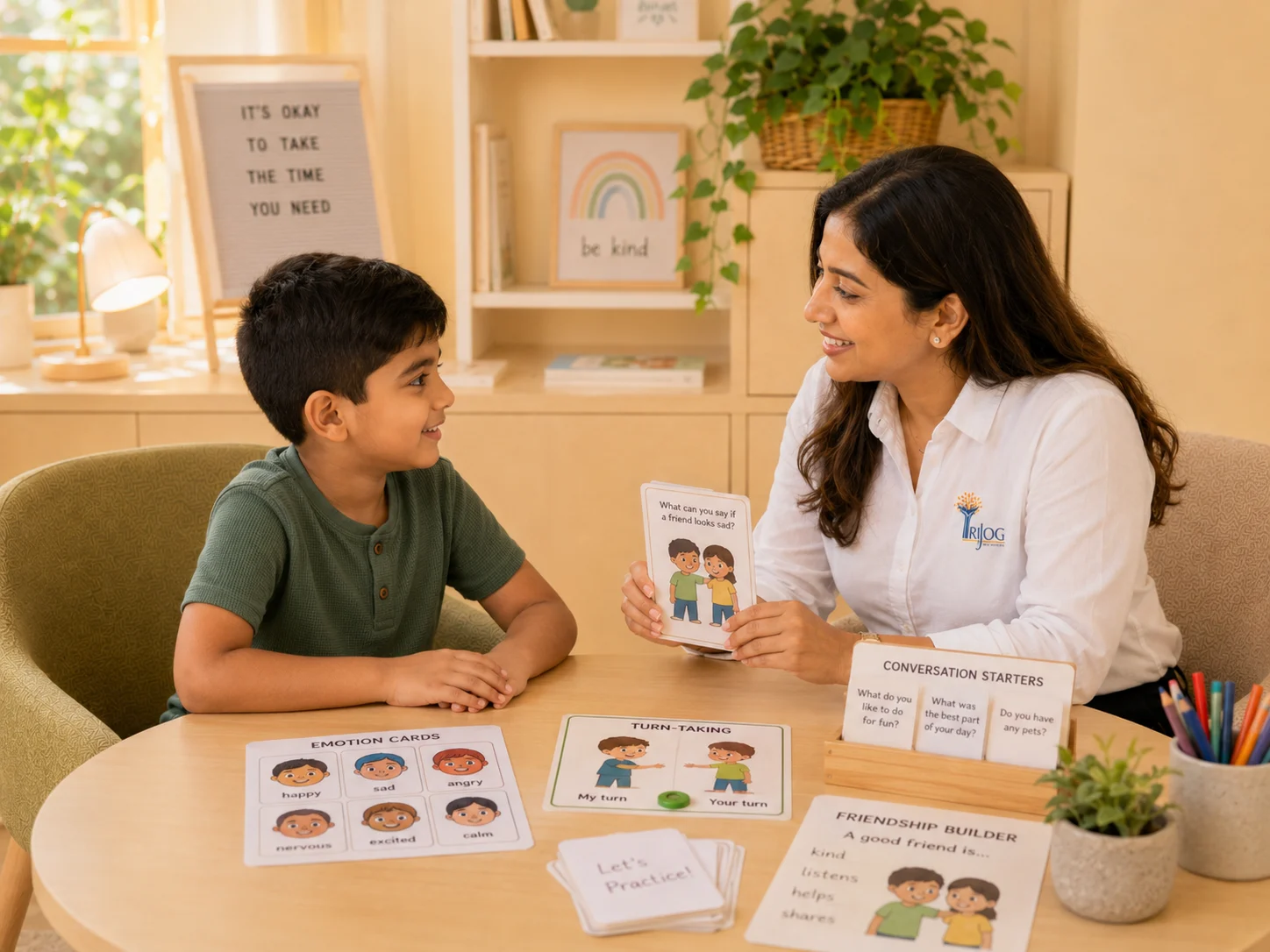
Therapy uses play and role-play to practise turn-taking, joining in and reading feelings, with ideas for teachers and parents to support the same skills.
Behaviour linked to anxiety or change
Behaviour that started after a move, a new sibling or a hard time.
Sometimes a sudden change in behaviour is the child’s way of coping with something else: a new school, a new baby, parents arguing, a loss in the family.
- Behaviour that changed suddenly
- Clinginess alongside outbursts
- Going back to younger behaviours
- Stomach aches or headaches on school days
Your therapist looks at the whole picture, not just the behaviour, and works on what your child is worried about as well as how they are showing it.
Also Here For You
Families often come to us for these too:
ADHD and attention support
When behaviour is tied to restlessness, impulsivity or focus.
Learn more
Parenting support
Guidance and support for you as a parent, on its own or alongside your child's therapy.
Learn more
Childhood anxiety
When worry and fear sit underneath the behaviour.
Learn more
Why This Kind Of Support Helps
Behaviour is communication
Children often act out what they cannot put into words. Understanding the reason makes change easier.
No blame
Difficult behaviour is not a sign of bad parenting or a bad child. It is a pattern, and patterns can change.
Parents are the biggest lever
Small, consistent changes at home usually matter more than anything that happens in a session.
No Crisis Needed
You can come while things still feel manageable, before habits become harder to shift.
How It Works
Reach out
Parent meeting first
Meet your child
Plan and practise
What A First Session Is Like
Nothing is expected of your child in the first meeting. Usually the therapist meets you first, to hear what you have noticed, when it happens and what you have tried. Your child then meets the therapist in a play room set up to feel friendly. By the end you will usually have one or two things to try at home.
Child Psychologists And Therapists
For assessment, therapy and practical guidance, in person or online.
A Specialist, If Needed
We can connect you with a paediatrician or psychiatrist when a medical opinion is worth having.
Parents, Always
You are part of the plan, with guidance on what to do at home.
For parents, grandparents and caregivers
Behaviour changes fastest when everyone at home responds in the same way. A few things help.
- Agree a few clear rules together, and keep them the same across adults.
- Notice and praise the behaviour you want, often and specifically.
- Stay calm during an outburst. Talk about it later, once everyone has settled.
- Look after yourself too. Supporting a child through this is tiring, and you deserve support.
If a child needs help right now
- If a child talks about wanting to die, harm themselves or not wanting to be here, or you believe they are in danger, call 112 or go to the nearest hospital emergency.
- For free mental health support at any time, for you or your child, call the government's Tele-MANAS helpline on 14416 or 1-800 891 4416.
- Trijog is not an emergency service. Our sessions are by appointment, in person in Mumbai or online.
If any of these is happening, please do not wait for an appointment. Call 112 or go to the nearest hospital emergency. Tele-MANAS is free and open any time on 14416 or 1-800 891 4416.
Frequently Asked Questions
Some tantrums, defiance and testing are a normal part of growing up. It is worth getting support if the behaviour is frequent, intense, getting worse, or affecting school, friendships or family life.
No. Many children who benefit from behaviour therapy have no diagnosis. If your therapist feels a formal assessment would help, they will discuss it with you first.
Yes. Parents are central to behaviour therapy. You will receive guidance and practice ideas to use at home.
Yes. When several adults share care, it helps if they understand the plan too. We can include them with your agreement.
Parent sessions work well online. Sessions with young children are often better in person, and your therapist will suggest what suits your child.
With your permission, your therapist can share strategies with your child’s teachers so the approach is consistent.
Visit Our Centres
Meet your child’s therapist in person at one of our three Mumbai centres.
Powai
406, 4th Floor, B-Wing, Powai Plaza, opp. Nirvana Park, Hiranandani Gardens, Powai, Mumbai 400076
Phone: 1800 202 7180
Time: Mon to Sat, 8:00 AM to 10:00 PM
Directions & Google reviews
Bandra
Office No. G6, Bandra Nicholas C.H.S Ltd, Sherlyn Rajan Road, Rizvi Complex, Bandra West, Mumbai 400050
Phone: 1800 202 7180
Time: Mon to Sat, 8:00 AM to 10:00 PM
Directions & Google reviews
Prabhadevi
Dr. Palep's Polyclinic, Manoj Co-Operative Hsg Society, Shankar Ghanekar Marg, opp. Rachana Sansad College of Architecture, Prabhadevi, Mumbai 400025
Phone: 1800 202 7180
Time: Mon to Sat, 8:00 AM to 10:00 PM
Directions & Google reviews
Start With One Conversation
You do not need to have it all figured out. Tell us what you are seeing, and we will take it from there.
If a child is thinking of ending their life or harming themselves, or is unsafe right now, call 112 or go to the nearest hospital emergency. For free support any time, call the government’s Tele-MANAS helpline on 14416 or 1-800 891 4416. Trijog is not an emergency service. Outside India, call your local emergency number.
Educational content, not therapy or a diagnosis. A Trijog therapist can help with what is specific to your child.