
Home / Adult Counselling / Anger Management
Anger Management Therapy
Anger is normal. It turns into a problem when it arrives too fast, stays too long, or leaves damage behind. Counselling works on the moment it rises, and on what keeps setting it off. Anger management therapy at Trijog works on both, in Mumbai or online.
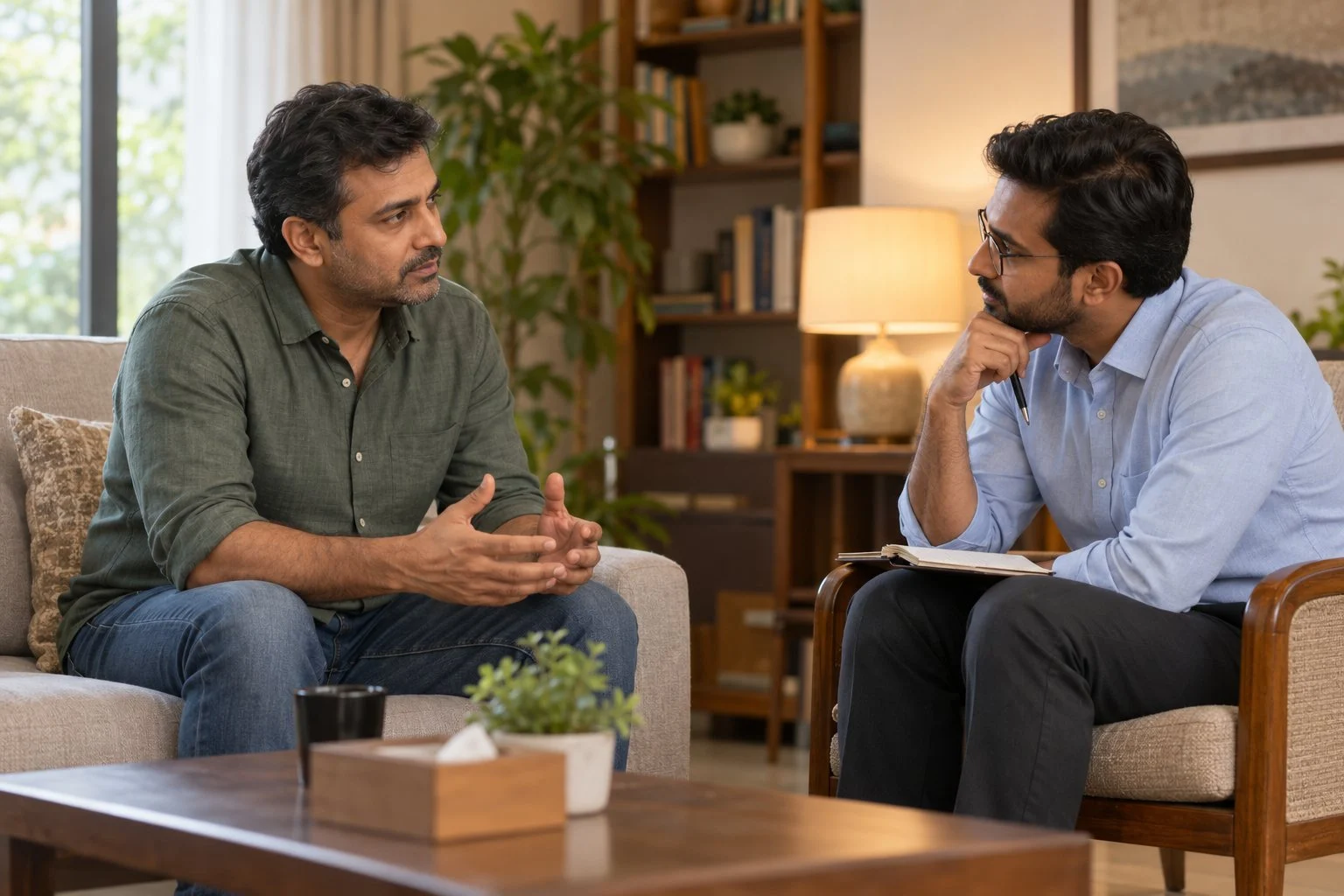
This is for adults who are tired of losing their temper, and for people whose family has asked them to get help. Trijog’s psychologists and counsellors meet you one-to-one, in person in Mumbai or online. Coming because someone else asked you to is a fine reason to come.
- Private, one to one
- In person at our Mumbai centres, or online
- Psychologists and counsellors, no lecturing
What We Help With
Pick what feels closest to your situation. Not sure which one? That is fine, we can work it out in the first conversation.
A short fuse and daily irritability
Snapping at small things most days, and getting tired of yourself.
Traffic, a slow queue, a phone that will not connect. The trigger is small and the reaction is not. Often poor sleep, pain, long hours or skipped meals have quietly raised your baseline before anything even happens.
- Small delays feel personal
- You are short with people who did nothing
- Jaw, chest or shoulders stay tight
- You cool down, then feel bad about it
Tracking what raises your baseline, sleep and routine, and catching the body signs early enough to do something with them.
Anger at home and with family
When most of it comes out at the people you live with.
Anger often waits until you get home. Spouse, parents, in-laws, children: the people who feel safest to shout at get the worst of it. Sessions look at what the fights are really about, and at the cost to the house.
- You hold it together outside and let go at home
- Children go quiet or leave the room when your voice rises
- Doors, phones or plates have been thrown
- The house watches your mood before speaking
The pattern at home, repair after a blow-up, and a plan the rest of the family can see rather than guess at.
Anger at work
Short replies, sharp emails, and a reputation you did not intend.
Work anger is usually swallowed and then leaked: a sarcastic reply, a cold email, a burst in a meeting. Being reasonable all day and losing it once is a common shape. So is quiet resentment that never gets said out loud.
- You replay conversations with your manager at night
- Feedback lands as an attack
- You have sent a message you regretted by morning
- People have started managing around you
Saying the hard thing early and plainly, taking feedback without heat, and the difference between being firm and being harsh.
Resentment after hurt or betrayal
Old anger that has settled in and will not move.
Some anger is not about today. A parent who never said sorry, a partner who broke trust, a brother and a property matter. It sits under the surface for years and colours everything you do with that person.
- You rehearse arguments you will never actually have
- Family events are dreaded weeks ahead
- Polite on the surface, a score sheet underneath
- One name can change your whole mood
Getting to what the anger is protecting, saying the unsaid part in a safe place, and deciding what you want with that relationship. Forgiveness is not the goal unless you want it to be.
Calming skills for the moment it rises
What to actually do in the seconds before it goes off.
Anger has a physical run-up: heart rate up, heat, tight chest, narrow thinking. Once the body is flooded, no conversation works. You learn to notice it early, and to take a real break instead of a slammed door.
- You notice the heat only after you have shouted
- Walking away feels like losing
- Counting to ten has never worked for you
- You go from calm to full anger with no middle
Early warning signs, slow breathing and cooling down, a break both people have agreed to in advance, and coming back to finish the conversation.
When anger frightens people around you (safety)
If your family is scared of you, this is the part to read.
Sometimes anger stops being only yours. Things get broken, someone gets grabbed or pushed, children go quiet when you walk in. There is work to do here, and it has to start with everyone in the house being safe, including you.
- Someone at home has said they are afraid of you
- You have hit, pushed, grabbed or blocked a doorway
- Objects have been thrown or broken during a fight
- You do not fully remember what you said afterwards
An honest look at what has already happened, a safety plan that protects the people at home, and work on the build-up. Therapy is not a substitute for safety. If anyone is in danger, that is a 112 call first.
Also Here For You
People often come to us for these too:
Anger and drinking
When the worst episodes follow a drink, the two get looked at together rather than one at a time.
Talk to us
Anger after a loss or a shock
Grief and hard memories often arrive as anger first. It is a common shape and it is easily missed by everyone, including you.
Talk to us
Irritability that came with low mood or poor sleep
Sometimes a short fuse is the first sign of something else going on, not a character flaw. Worth checking rather than assuming.
Talk to us
Why This Kind Of Support Helps
Anger is more a skill gap than a character flaw
Most people who blow up already know they should not. Knowing is not the missing piece. What to do in the seconds before it goes off is.
Other people are affected, so they are part of the plan
With your permission, your family can be told what you are working on and what to do when it starts. That works better than a private effort nobody can see.
Shame makes it worse, not better
Being told you are a bad partner or a bad parent does not lower anger, it adds to the load. Sessions stay direct about behaviour and stay off your worth.
No Crisis Needed
You can come while things still feel small, or hard to put into words.
How It Works
Reach out
First session
Agree the plan
Review as you go
What A First Session Is Like
Your therapist will ask you to walk slowly through one recent episode: what happened just before, what your body did, what went through your mind, what you did, and what happened after. That chain is where the useful detail sits. They will also ask direct questions about safety at home. Nobody is there to tell you off, and you will not be asked to promise anything.
Psychologists And Counsellors
For talking therapy, one to one, in person or online.
A Psychiatrist, If Needed
For a medical opinion when medicine is worth discussing.
Family, If You Want
Joint sessions with the people close to you, only if you choose.
If it is someone else's anger
Many people read a page like this for someone else: a husband, a wife, a parent or a grown child. You are allowed to get support for yourself even if that person never comes in.
- Your safety comes before their treatment. If you are frightened, act on that first
- You can have sessions on your own, and what you say stays with your therapist
- Nobody will tell you to stay in a situation, and nobody will tell you to leave it
- If you want, your therapist can help you think through how to raise it with them
If you need help right now
- If anyone is in danger right now, including you, call 112. That comes before any session, any plan and any apology.
- If your anger has already turned physical, or someone at home has said they are afraid of you, say so in the first session. Therapy is not a substitute for safety, and a safety plan is part of the work, not a punishment.
- If you are thinking of ending your life or of self-harm, call 112 or go to the nearest hospital emergency. Tele-MANAS is free and open any time on 14416 or 1-800 891 4416. Trijog is not an emergency service. Outside India, call your local emergency number.
If any of these is happening, please do not wait for an appointment. Call 112 or go to the nearest hospital emergency. Tele-MANAS is free and open any time on 14416 or 1-800 891 4416.
Try A Free Self-Check
Want a quick read on where you are right now? A short stress and mood check takes a few minutes. It is free, it is not a diagnosis, and you can bring the result to your first session.
Mood Check
Stress And Worry Check
Frequently Asked Questions
Fees depend on the therapist and the type of session. Ask the team when you book, so there is nothing unexpected later.
What you share stays between you and your therapist. There are a few exceptions, such as when someone’s safety is at serious risk or the law requires it. Your therapist will explain these in the first session.
Both. Alongside talking you practise things: spotting the build-up, slowing your breathing, taking a break that was agreed in advance, and saying the difficult thing early instead of storing it. Most of the practice happens between sessions.
It can be, and it is your choice. Many people do individual sessions with one or two joint sessions. Your therapist will check first that a joint session is the right and safe step for both of you.
Tell the team which language you are most comfortable in when you book, and they will match you with a therapist who speaks it.
Say so. You can ask to change therapists, or to stop. A poor fit is common and it is not a failure.
Visit Our Centres
Meet your therapist in person at one of our three Mumbai centres, or join online from home.
Powai
406, 4th Floor, B-Wing, Powai Plaza, opp. Nirvana Park, Hiranandani Gardens, Powai, Mumbai 400076
Phone: 1800 202 7180
Time: Mon to Sat, 8:00 AM to 10:00 PM
Directions & Google reviews
Bandra
Office No. G6, Bandra Nicholas C.H.S Ltd, Sherlyn Rajan Road, Rizvi Complex, Bandra West, Mumbai 400050
Phone: 1800 202 7180
Time: Mon to Sat, 8:00 AM to 10:00 PM
Directions & Google reviews
Prabhadevi
Dr. Palep's Polyclinic, Manoj Co-Operative Hsg Society, Shankar Ghanekar Marg, opp. Rachana Sansad College of Architecture, Prabhadevi, Mumbai 400025
Phone: 1800 202 7180
Time: Mon to Sat, 8:00 AM to 10:00 PM
Directions & Google reviews
Try a Short Practice


Start With One Conversation
You do not need the right words ready. Tell us what has been going on, and we will take it from there.
If you are thinking of ending your life or harming yourself, or you feel unsafe right now, call 112 or go to the nearest hospital emergency. For free support any time, call the government’s Tele-MANAS helpline on 14416 or 1-800 891 4416. Trijog is not an emergency service. Outside India, call your local emergency number.
Educational content, not therapy or a diagnosis. A Trijog therapist can help with what is yours specifically.