
Home / Child Counselling / Childhood Anxiety
Counselling for Childhood Anxiety and Worries
Tummy aches every school morning. Not sleeping alone. Panicking before tests. Children worry too, and they often show it through their bodies and behaviour before they can say it.
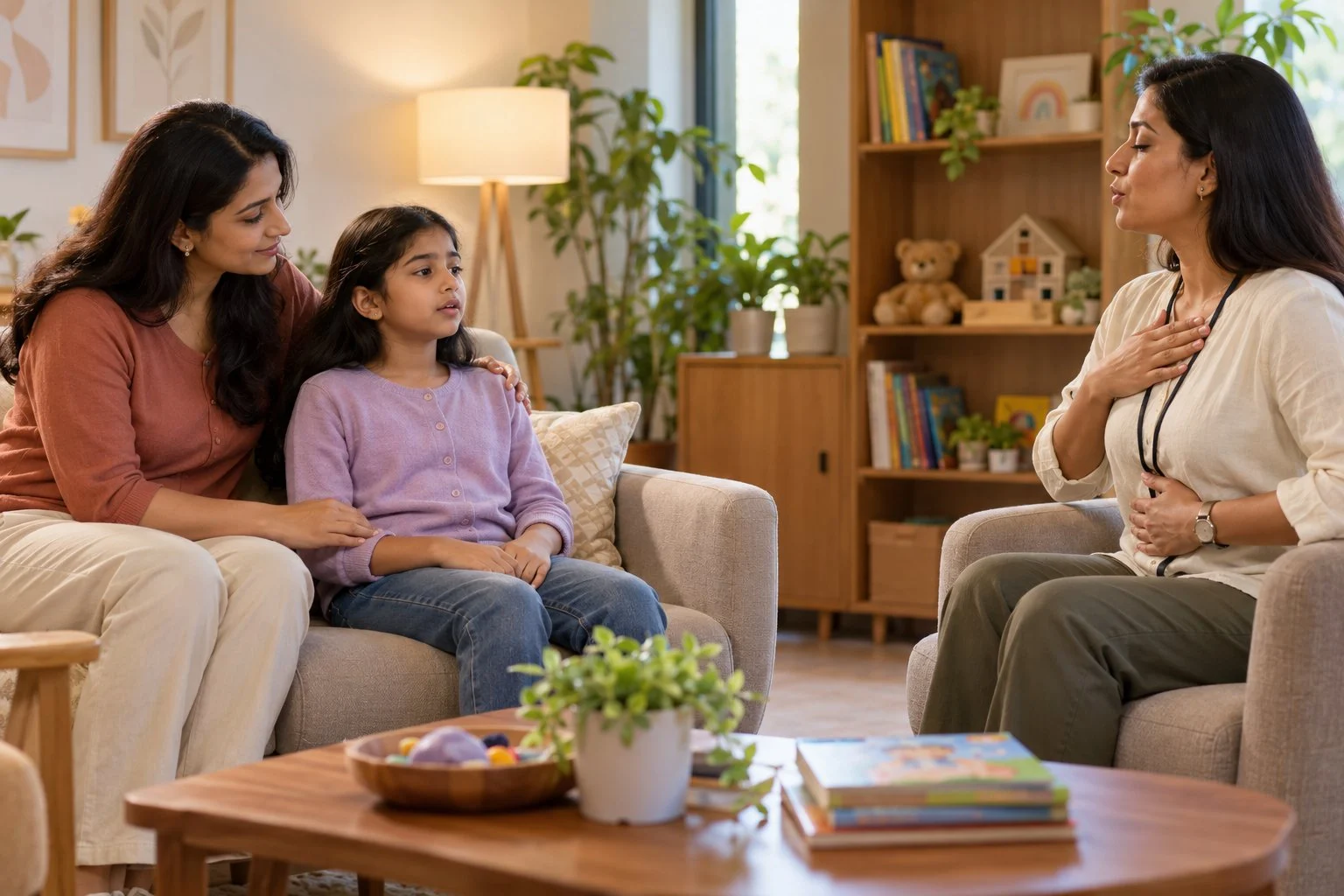
Trijog’s child psychologists help children understand their worries and learn to face them, using play, stories and practical techniques suited to their age, in person in Mumbai or online. Parents are part of the work.
- Gentle, play-based and age-appropriate
- In person at our Mumbai centres, or online
- Parents part of every plan
What We Help With
Pick what feels closest to what you are seeing. Not sure which one? That is fine, we can work it out in the first conversation.
Separation worries
Difficulty being apart from parents.
Crying at drop-off, refusing sleepovers, or following you from room to room. Some separation worry is normal at certain ages, but sometimes it stays and grows.
- Distress when a parent leaves
- Refusing to sleep alone
- Worrying something bad will happen to you
- Clinginess in new places
Your child learns brave steps in small stages, while parents learn how to support without accidentally feeding the worry.
School refusal and school worries
Dreading school, or finding reasons not to go.
Tummy aches on Monday mornings that vanish by Saturday. Tears at the gate. Sometimes it is about friends, teachers, tests or something that happened.
- Physical complaints on school days
- Tears or tantrums before school
- Asking to come home early
- Avoiding school activities
Therapy looks at what is behind the worry and plans a gradual return, working with school with your permission.
Fears and phobias
Strong fears of the dark, dogs, insects, loud noises or other things.
Most children have fears, but some become so strong that they limit what the family can do.
- Refusing to go places because of the fear
- Panic when the feared thing appears
- Needing a parent nearby at night
- Fear that grows rather than fades
Your child learns about the fear in an age-friendly way, then faces it step by step, at a pace they agree to.
Exam and performance worries
Freezing, panicking or feeling sick before tests.
Bright children sometimes go blank in exams, or get so anxious beforehand that they cannot study. Pressure around marks is common in Indian schools.
- Feeling sick before tests
- Going blank in exams
- Perfectionism and fear of mistakes
- Tears over homework or marks
Children learn calming skills, realistic thinking and study routines, and parents learn ways to talk about marks that lower the pressure.
Social worries and shyness
Fear of speaking up, joining in or being judged.
Some children go quiet in class, avoid birthday parties or cannot answer the phone. It is often called shyness, but it can cause real distress.
- Not speaking in class or to adults
- Avoiding parties and group activities
- Worrying what others think
- Few chances to make friends
Play and role-play help children practise social situations, building confidence in small, manageable steps.
Worries that show up in the body
Stomach aches, headaches and sleep problems with no medical cause.
Children often feel worry in their bodies. After a doctor has checked things, it is worth considering whether stress or anxiety is part of the picture.
- Frequent stomach aches or headaches
- Difficulty falling asleep
- Nightmares or waking at night
- Changes in appetite
Your child learns to notice what their body is telling them, and practises simple ways to relax, alongside work on the underlying worry.
Also Here For You
Families often come to us for these too:
Behaviour therapy
When worry is showing up as tantrums or difficult behaviour.
Learn more
Teen counselling
For older children and teenagers with stress, mood or worries.
Learn more
Parenting support
Help for you in supporting an anxious child.
Learn more
Why This Kind Of Support Helps
Worry is common and treatable
Anxiety is one of the most common difficulties in childhood, and children respond well to support.
Parents can help a lot
Small changes in how adults respond to worry make a big difference.
Avoidance keeps fear going
Helping children face fears gently, rather than avoid them, builds lasting confidence.
No Crisis Needed
You can come when the worry first starts to get in the way.
How It Works
Reach out
Parent meeting
Meet your child
Brave steps
What A First Session Is Like
Your child will not be asked to face anything in the first session. They will meet the therapist in a friendly room, often through drawing, games or stories about worries. You will be asked about your child’s history, sleep, school and family life, and you will leave with first ideas to try.
Child Psychologists And Therapists
For assessment, therapy and practical guidance, in person or online.
A Specialist, If Needed
We can connect you with a paediatrician or psychiatrist when a medical opinion is worth having.
Parents, Always
You are part of the plan, with guidance on what to do at home.
For parents and caregivers
How adults respond to worry can make it shrink or grow. A few things help.
- Listen and name the feeling: "You are worried about going to school."
- Reassure once, calmly, rather than over and over.
- Praise brave steps, however small.
- Model calm. Children watch how adults handle their own worries.
If a child needs help right now
- If a child talks about wanting to die, harm themselves or not wanting to be here, or you believe they are in danger, call 112 or go to the nearest hospital emergency.
- For free mental health support at any time, for you or your child, call the government's Tele-MANAS helpline on 14416 or 1-800 891 4416.
- Trijog is not an emergency service. Our sessions are by appointment, in person in Mumbai or online.
If any of these is happening, please do not wait for an appointment. Call 112 or go to the nearest hospital emergency. Tele-MANAS is free and open any time on 14416 or 1-800 891 4416.
Frequently Asked Questions
Yes. Worries and fears are a normal part of childhood. It is worth getting support when worry is frequent, intense, or stopping your child from doing everyday things.
It could be. Please have a doctor check first. If there is no medical cause, stress or worry may be part of the picture.
Only gently, in small steps, and with your child’s agreement. Children set the pace with their therapist.
For many children, especially older ones, yes. Younger children often do best in person.
Yes. Parents are an important part of helping children with anxiety.
Most children with anxiety are helped by therapy. Our therapists do not prescribe. If medicine is worth discussing, we can connect you with a child psychiatrist.
Visit Our Centres
Meet your child’s therapist in person at one of our three Mumbai centres.
Powai
406, 4th Floor, B-Wing, Powai Plaza, opp. Nirvana Park, Hiranandani Gardens, Powai, Mumbai 400076
Phone: 1800 202 7180
Time: Mon to Sat, 8:00 AM to 10:00 PM
Directions & Google reviews
Bandra
Office No. G6, Bandra Nicholas C.H.S Ltd, Sherlyn Rajan Road, Rizvi Complex, Bandra West, Mumbai 400050
Phone: 1800 202 7180
Time: Mon to Sat, 8:00 AM to 10:00 PM
Directions & Google reviews
Prabhadevi
Dr. Palep's Polyclinic, Manoj Co-Operative Hsg Society, Shankar Ghanekar Marg, opp. Rachana Sansad College of Architecture, Prabhadevi, Mumbai 400025
Phone: 1800 202 7180
Time: Mon to Sat, 8:00 AM to 10:00 PM
Directions & Google reviews
Start With One Conversation
You do not need to have it all figured out. Tell us what you are seeing, and we will take it from there.
If a child is thinking of ending their life or harming themselves, or is unsafe right now, call 112 or go to the nearest hospital emergency. For free support any time, call the government’s Tele-MANAS helpline on 14416 or 1-800 891 4416. Trijog is not an emergency service. Outside India, call your local emergency number.
Educational content, not therapy or a diagnosis. A Trijog therapist can help with what is specific to your child.